
What Is the Utilization Rate Formula? How to Calculate It (With Examples)

What is the utilization rate?
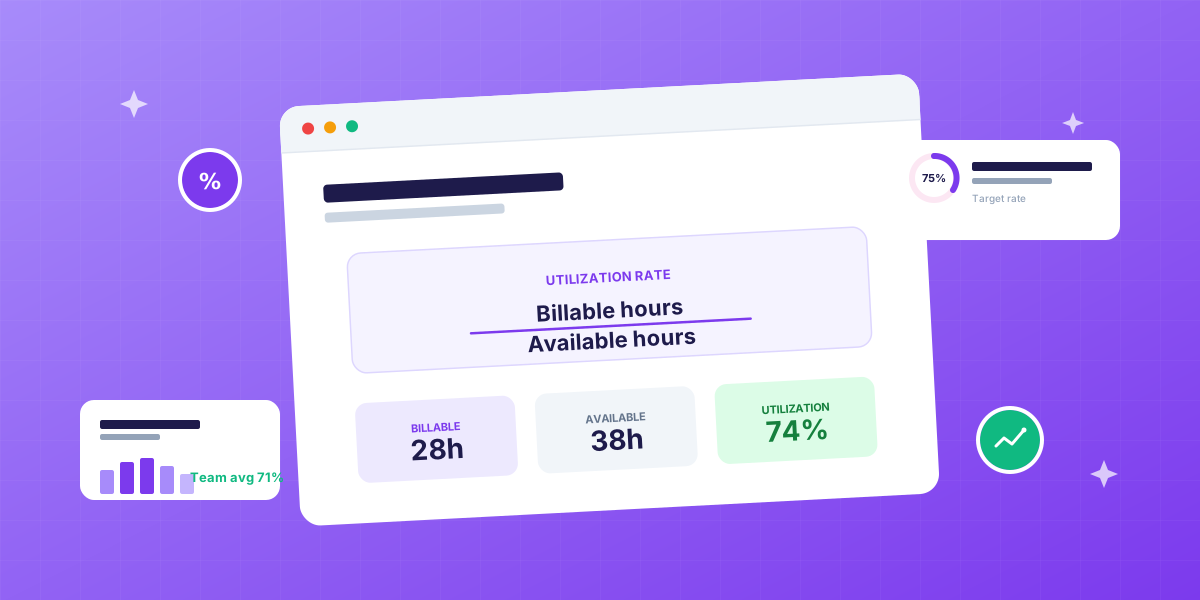
The utilization rate is the percentage of someone’s available working hours that get spent on billable, client-paying work. Deloitte’s professional services benchmarks consistently identify utilization rate as one of the top three KPIs that predict service-firm profitability.
If a developer has 40 available hours in a week and logs 30 of them against client projects, the utilization rate is 30 ÷ 40 = 75%. The other 10 hours went to meetings, training, admin, or other internal work.
In a service business, utilization rate is one of the three numbers that decide profitability, alongside billable hours and average hourly rate. Get utilization wrong by 5 percentage points and the P&L follows.
What is the utilization rate formula?
The standard formula is: Utilization rate = (Billable hours ÷ Available hours) × 100.
But “billable hours” and “available hours” can each be defined two ways, which means there are really three formulas in common use. They answer different questions.
1. Basic utilization
Basic utilization = (Logged hours ÷ Available hours) × 100
Measures how much of available time was spent working at all, billable or not. Used to spot people who are clocking out early or stretched too thin.
2. Billable utilization
Billable utilization = (Billable hours ÷ Available hours) × 100
Measures how much of available time generated revenue. This is the one that matters for agency margin. Default for service businesses.
3. Capacity utilization
Capacity utilization = (Logged hours ÷ Total capacity) × 100
Where Total capacity = scheduled hours including PTO, holidays and sick days. Used by ops teams to compare different periods or different team sizes apples-to-apples.
When someone says “our utilization is 74%” without specifying, they almost always mean billable utilization. That’s the one you’ll see on a CFO’s dashboard.
How do you calculate the utilization rate? (Worked example)
A senior designer named Lisa, one week in May:
| Metric | Value |
|---|---|
| Scheduled hours | 40 |
| PTO this week | 0 |
| Available hours | 40 |
| Hours logged to client projects (billable) | 28 |
| Hours logged to internal projects (non-billable) | 4 |
| Total logged hours | 32 |
| Hourly rate | €95 |
Three utilization rates for Lisa this week:
- Basic utilization: 32 ÷ 40 = 80%
- Billable utilization: 28 ÷ 40 = 70%
- Capacity utilization: 32 ÷ 40 = 80% (no PTO this week, so same as basic)
Lisa’s revenue this week: 28 × €95 = €2,660.
The interesting number is the gap between basic (80%) and billable (70%). That 10-point gap is the cost of internal work, meetings, retros, learning. Worth doing, but it’s not free.
What is a good utilization rate?
The honest answer: it depends on the role and the business model. But here are the benchmarks for client-facing service roles.
| Utilization rate | What it means |
|---|---|
| Below 50% | Unsustainable, overhead or sales pipeline problem |
| 50-65% | Below benchmark, margin leaking |
| 65-75% | Healthy zone, buffer for non-billable, profitable enough |
| 75-85% | High, only with deliberate lean overhead |
| Above 85% | Burnout zone, top people leave within a year |
By role:
| Role | Target billable utilization |
|---|---|
| Senior consultant / developer | 65-75% |
| Junior consultant / developer | 75-85% |
| Project manager | 50-65% |
| Account manager | 40-60% |
| Designer / specialist | 65-75% |
| Department lead | 30-50% |
Juniors run higher because they have fewer internal commitments. Senior roles run lower because mentoring, sales support and strategy work eat hours. A team-wide target of “85% for everyone” is a target nobody hits and nobody trusts.
Why is 100% utilization bad?
Because it leaves no buffer for the work that actually keeps a business running. Harvard Business Review research finds sustained 95%+ utilization correlates strongly with attrition among top performers.
A 40-hour scheduled week realistically contains:
| Hours per week | Where they go |
|---|---|
| 40 | Scheduled |
| -4 to -6 | Internal meetings, retros |
| -2 to -3 | Admin, expense reports, timesheet entry |
| -2 to -3 | Training, learning, context switching |
| 28-32 | Actually available for billable work |
So even at 100% theoretical efficiency, billable utilization caps at roughly 75-80% for a healthy 40-hour scheduled employee.
Planning to 100% means the first surprise, a sick day, a scope change, an urgent sales call, blows up the schedule. Healthy resource management plans to 75-85% deliberate utilization of available hours, leaving a 15-25% buffer that absorbs reality.
The number to target isn’t the highest possible. It’s the highest sustainable.
How do you calculate utilization rate for a team?
For one person, the formula is straightforward. For a team, you have to pick how to aggregate.
Method 1: Simple average
Team utilization = average of individual utilization rates
Quick, but weights everyone equally. A 30-hour part-timer at 100% pulls the average up the same as a 40-hour full-timer at 70%.
Method 2: Weighted by available hours
Team utilization = Σ billable hours ÷ Σ available hours
Treats one billable hour the same regardless of which person logged it. This is the right method for revenue forecasting.
Method 3: Weighted by cost or rate
Weighted utilization = Σ (billable hours × rate) ÷ Σ (available hours × rate)
Used for senior-heavy teams where one expensive consultant’s 5 unused hours hurt more than five juniors’ 5 unused hours. The right method for margin analysis.
A 12-person team, one week:
| Person | Available | Billable | Util % |
|---|---|---|---|
| Sarah (senior) | 40 | 24 | 60% |
| Marc (mid) | 40 | 32 | 80% |
| Jen (junior) | 40 | 34 | 85% |
| … | … | … | … |
| Total (12) | 480 | 340 | , |
- Simple average: 71%
- Weighted by hours: 340 ÷ 480 = 71%
- Weighted by rate (assuming senior rates 2× juniors): often 65-68%
When the three methods diverge, you have a senior-junior imbalance worth investigating.
What are the most common utilization rate calculation mistakes?
Six mistakes distort the number in almost every agency.
1. Counting PTO in “available hours”
Someone takes Monday off. Their available hours that week are 32, not 40. Counting PTO inflates the denominator and makes utilization look worse than it is. Always subtract approved time off from available.
2. Treating overtime as extra utilization (>100%)
Someone works 50 hours and logs 45 billable. Their utilization “looks like” 45 ÷ 40 = 112%. That’s not real. It’s burnout in disguise. Cap individual utilization at 100% in reporting; surface overtime separately.
3. Mislabeling non-billable as billable
An internal training project tagged as a “client project” because it has the client’s name on it. Or a sales pitch logged as “client meeting.” Garbage in, garbage out. Audit the project list quarterly. Which tool you log in matters here too: our comparison of time tracking software puts eight of them side by side with what a team of 10 pays.
4. Mixing time periods
Comparing this week’s utilization (74%) to last quarter’s (68%) without normalizing. A holiday week reads lower because available hours dropped. Normalize against available hours, not against scheduled hours.
5. Forgetting contractors
You have 8 employees and 3 contractors who all log time. If you exclude contractors from the denominator but include their billable hours in the numerator, utilization looks great, and fictitious. Decide who’s in the calculation and stick to it.
6. No gap between target and actual
“Our target is 80% and we’re at 80%” sounds healthy. But target = actual every week means the target is being managed, not the work. Track variance, not just the level.
Utilization rate vs related metrics
These get confused all the time.
| Metric | What it measures |
|---|---|
| Utilization rate | % of available hours spent on billable work |
| Productivity | Output produced per hour |
| Realization rate | % of billed hours that actually get paid (after write-offs) |
| Effective rate | Realized revenue ÷ hours logged |
| Capacity utilization | % of total capacity used (including PTO) |
| Efficiency | Time taken vs time estimated |
Utilization and productivity are not the same. Someone at 90% utilization who delivers slow, low-quality work is utilized but not productive. Someone at 60% utilization who delivers exceptional work is productive but underutilized.
Healthy businesses track both. Utilization alone tells you nothing about quality. Productivity alone tells you nothing about whether you’re making money on it.
How does utilization rate work in an agency context?
For multi-client agencies, one team-wide utilization number isn’t enough. You need to slice it.
Per role: are seniors carrying too much? Are juniors underutilized? Per client: is one client absorbing 40% of someone’s capacity? That’s a concentration risk. Per project: is the project running at the utilization implied in the proposal? Over time: is utilization trending up, down, or jagged? Jagged usually means weak resource planning, not weak salespeople.
Connecting utilization back to billable hours, resource management and capacity planning is where the formula stops being a spreadsheet exercise and starts being an operating system.
Utilization rate formula in short
- The standard formula:
(Billable hours ÷ Available hours) × 100 - Three variants: basic, billable, capacity, billable is the default for service businesses
- Healthy range: 65-75% for most agency roles
- Subtract PTO from available hours, always
- Cap at 100% in reporting: overtime is burnout, not utilization
- Plan to 75-85% deliberate utilization, never 100%
- Aggregate by weighted hours, not by simple average, for accurate team rates
- Targets vary by role: juniors higher, senior leaders lower
- Utilization ≠ productivity: track both, they answer different questions
See your real utilization in real time
FlowQi calculates utilization automatically from time tracking, with live breakdowns per person, role, project and client. See the resource management module or book a free demo to see your own numbers.