
What Is Resource Management? Definition, Functions, and Best Practices

What is resource management?
Resource management is the discipline of getting the right people on the right work at the right time, and keeping that working as conditions change. The Project Management Institute defines it as the efficient and effective deployment of an organization’s resources when they’re needed.
The resources being managed are:
- People: your team members, with their skills, seniority and availability
- Time: the hours each person can realistically deliver per week
- Tools: software seats, equipment, licenses, meeting rooms
- Budget: the financial limits behind each piece of work
In a service business, agency, consultancy, IT firm, design studio, these resources are what you sell. Manage them well and you ship profitable work. Manage them poorly and you end up with one of three outcomes: burnt-out top performers, idle bench time you can’t bill, or projects that quietly bleed margin.
Resource management is sometimes called resourcing, resource planning, or simply capacity. The labels vary; the practice is the same.
Why does resource management matter?
Because resources are finite, and in a service business, they’re also your main cost and your only revenue source. How you manage them shows up directly on the P&L.
Margin
Senior people on senior work, junior people on junior work. When that gets reversed, even slightly, costs climb without compensating revenue.
Team health
Predictable allocation prevents predictable burnout. Without it, the same two reliable people get every new project until one of them quits.
Client outcomes
Right person, right project, right time means deadlines hit and quality stays high. Wrong combination and projects slip, clients notice within weeks.
Forecasting
Resource management answers “can we take on the Retail deal in six weeks?” without guessing. Without it, you find out by signing first and then panicking.
Industry research consistently shows agencies lose 15 to 20 percent of margin to poor resource management. Not from external causes, from internal inefficiency that compounds week over week.
Resource management vs related concepts
These terms overlap, but each means something specific.
| Term | What it actually is |
|---|---|
| Resource management | The full practice, planning, allocating, tracking, forecasting, reporting |
| Resource allocation | The act of assigning specific resources to specific work |
| Capacity planning | Deciding whether you can take on work in a given period |
| Workload management | Balancing how much each person is doing right now |
| Resource forecasting | Predicting future resource needs 4-12 weeks ahead |
| Resource scheduling | Plotting allocated work onto a calendar |
| Workforce planning | Hiring, growth and team-composition planning |
Think of resource management as the umbrella. Allocation, capacity planning, forecasting and scheduling are the activities under it.
What are the five core functions of resource management?
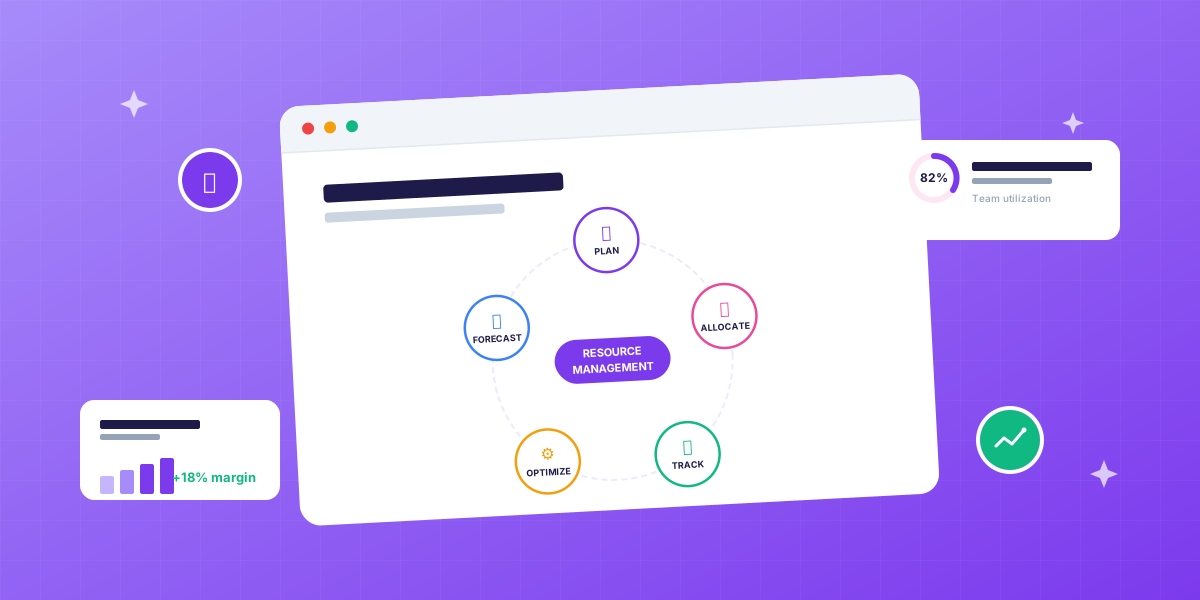
Five functions form a loop that runs weekly in well-managed agencies. Each one feeds the next.
1. Planning
Map out the work coming in and the resources you have. Forecast what’s likely over the next 4-12 weeks. This is where you spot gaps before they become emergencies.
2. Allocating
Assign specific people to specific work based on skills, availability and project priorities. This is the part most people picture when they think “resource management”, but it’s only one function.
3. Tracking
Compare what you planned against what’s actually happening. Are people working the hours you allocated? Are projects burning through their budgets? Tracking is where reality meets the plan.
4. Optimizing
Adjust as things shift. Someone gets sick, a project scopes up, a deal closes, reallocate. Resource management that doesn’t adjust is just documentation.
5. Forecasting
Predict resource needs further out. Are we short on senior developers in Q3? Will winning two pipeline deals require hiring? Forecasting is where resource management becomes strategic instead of reactive.
Together, these five functions form a loop. Plan → allocate → track → optimize → forecast → plan again.
How does the resource management lifecycle work in an agency?
In an agency, resource management moves a project through five stages.
Stage 1: Pipeline forecasting
A pipeline deal in CRM signals a future resource need. Resource management asks: do we have capacity in six weeks?
Stage 2: Initial allocation
Deal closes. Project gets created. People are allocated to specific tasks with hour budgets.
Stage 3: Active tracking
Work happens. Hours get logged. The plan meets reality, and reality wins more often than not.
Stage 4: Mid-project adjustment
Half-way through, you realize someone is at 110% capacity. Reallocate. Push deadlines if needed. Talk to the client before the wall.
Stage 5: Post-project review
What did the project actually cost in hours? Was margin healthy? Use the data to plan better next time.
Most agencies skip Stages 1 and 5. They go straight from “we got the deal” to “we’re shipping”, and never review afterwards. Resource management is the practice of doing all five.
What are the most common resource management mistakes?
Six mistakes account for almost every resource management failure.
1. Planning at 100% utilization
The math says you have 40 productive hours per person. The reality is 28-32. Plan to 75-85% utilization and protect the buffer.
2. Treating allocation as a one-time event
You allocate on Monday. Reality changes on Tuesday. If your resource plan doesn’t update with reality, by Friday it’s fiction.
3. Ignoring skill match
“Mark has 12 hours free” doesn’t mean Mark should do this task. Always match on skills and hours, never just hours.
4. Forgetting non-billable work
Internal meetings, training, admin, sales support, all eat hours. If you allocate 40 hours of client work to someone who has 15 hours of internal commitments, you’ve created a 55-hour week.
5. No forecasting
You only look at this week’s allocations. The deal that closes in six weeks will collide with the project already booked. Resource management without forecasting is firefighting.
6. Tools that don’t talk
Resource planning in one tool, time tracking in another, invoicing in a third. Data doesn’t sync. Numbers drift. Reality is a guess. What the dedicated schedulers and the all-in-one platforms each cost for a team of 10 is in our comparison of resource management software.
How does resource management work in an agency context?
Agencies face three resource management realities that simpler businesses don’t.
1. Multi-client parallelism. You’re not managing resources for one project. You’re managing them across 8 to 15 active projects with different clients, deadlines and priorities.
2. Skills heterogeneity. Designers, developers, copywriters, strategists, project managers, each with seniority levels, specialties and rates. Resource management has to respect all of those.
3. Billable accountability. Every hour allocated should map back to a billable client project, or be clearly tagged as internal. Otherwise you can’t invoice accurately, and you can’t measure utilization.
This is why agency-specific resource management platforms integrate four things in one workspace:
- CRM: to see pipeline deals that affect future capacity
- Projects: where allocations live, with budgets and milestones
- Time tracking: so allocated hours can be compared to worked hours
- Invoicing: so billable work flows directly into revenue
Without that integration, you have a stack. With it, you have a system.
What role does AI play in resource management?
AI is changing what’s possible in resource management, not by replacing managers, but by surfacing the right signals at the right moment. McKinsey research shows AI-augmented resource planning can improve forecasting accuracy by 20-50% in service businesses.
What modern AI does well in resource management:
- Alerts to overload before it happens (“Lisa is at 45 hours next week”)
- Suggests reallocations based on real-time skills + availability data
- Detects margin risk (“Project Retail is 8 hours over budget”)
- Forecasts impact of pipeline deals (“Winning two more deals means hiring or shifting timelines”)
FlowQi runs Hummy, an AI agent that watches resource patterns and flags issues. It proposes; you decide. AI doesn’t take resource management out of human hands. It just makes the hands faster.
Resource management in short
- The full practice of planning, allocating, tracking, optimizing and forecasting resources
- Broader than resource allocation (one step) and different from capacity planning (one input)
- Agencies lose 15-20% of margin to poor resource management
- Five functions form a loop: plan → allocate → track → optimize → forecast
- Realistic capacity: 28-32 billable hours per full-timer
- Plan to 75-85% utilization, never 100%
- Match on skills first, then hours
- Review weekly: not when problems hit
- For agencies, resource management has to connect to billing to be useful
Try FlowQi resource management free
Good resource management is invisible when it works. FlowQi’s resource management module connects planning, allocation, time tracking and invoicing in one workspace, built for multi-client, multi-skill, billable-hours reality. Book a free demo and see it on your own team data.