
What Are Billable Hours? Meaning, Chart, Calculation and a Healthy Ratio

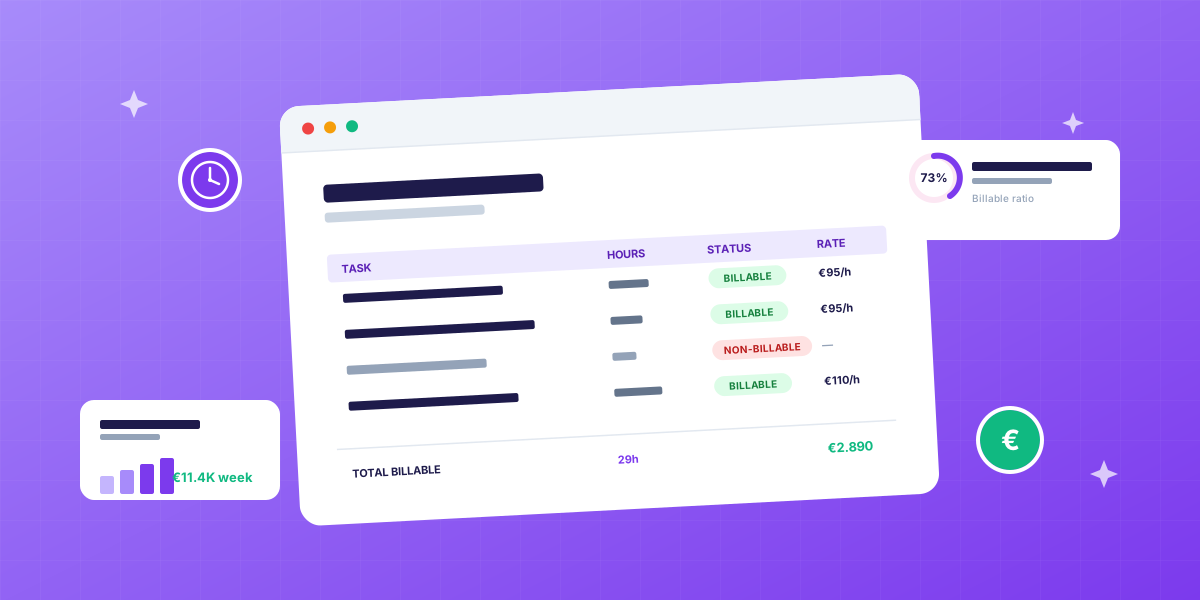
What are billable hours?
Billable hours are the hours a person works that can be charged to a client at an agreed hourly rate. Harvard Business Review research consistently shows billable hours remain the dominant pricing model across professional services, and the single biggest driver of agency margin.
If a designer spends 6 hours building a client’s landing page at €95/hour, those 6 hours are billable. They convert to €570 in revenue on the next invoice.
If the same designer then spends 2 hours in an internal team meeting, those 2 hours are non-billable. The company still pays the designer’s salary for that time, but no client invoice gets generated.
In a service business, agency, consultancy, law firm, IT services, design studio, billable hours are the closest thing to a single number that explains profit or loss.
What is the difference between billable and non-billable hours?
Every hour someone on your team works falls into one of two buckets.
| Type | Description | Examples |
|---|---|---|
| Billable | Hours that link directly to a client project and can be invoiced | Design work, development, copywriting, client meetings, project management on a paid engagement |
| Non-billable | Hours your business pays for but cannot charge to a client | Internal meetings, training, sales pitches, admin, holidays, sick days, proposals, tool setup |
Both types are real and necessary. You can’t run an agency on 100% billable hours. There’s always overhead. But you also can’t run one on 40% billable hours either. You’d be paying people to do work nobody pays you for.
The job of resource management isn’t to push billable hours to 100%. It’s to find the right ratio for your business and protect it.
How do you calculate billable hours?
The math is simple. The hard part is tracking honestly.
1. Track every hour worked: split between billable (tagged to a client project) and non-billable (internal).
2. Sum billable hours weekly per person:
Billable hours = Σ (hours tagged to a client project)
3. Calculate the billable ratio:
Billable ratio = Billable hours ÷ Available hours
4. Calculate revenue per person:
Weekly revenue = Billable hours × Hourly rate
Worked example: A senior developer has 38 available hours in a week. 28 of those are tagged to client projects at €110/hour. 10 go to internal work (sprint planning, code review on internal tools, a training session).
- Billable hours: 28
- Billable ratio: 28 ÷ 38 = 74%
- Weekly revenue: 28 × €110 = €3,080
Multiply that by 46 working weeks and you have your annual revenue per developer at this billable rate: €141,680.
Billable hours chart: minutes to tenths and quarters
Most firms do not bill in minutes. They bill in increments. US law firms and many consultancies use tenths of an hour (six-minute blocks); agencies and freelancers more often use quarters (fifteen-minute blocks). A billable hours chart converts what you worked into what goes on the invoice.
| Minutes worked | Tenths of an hour |
|---|---|
| 1 to 6 | 0.1 |
| 7 to 12 | 0.2 |
| 13 to 18 | 0.3 |
| 19 to 24 | 0.4 |
| 25 to 30 | 0.5 |
| 31 to 36 | 0.6 |
| 37 to 42 | 0.7 |
| 43 to 48 | 0.8 |
| 49 to 54 | 0.9 |
| 55 to 60 | 1.0 |
| Minutes worked | Quarters of an hour |
|---|---|
| 1 to 15 | 0.25 |
| 16 to 30 | 0.5 |
| 31 to 45 | 0.75 |
| 46 to 60 | 1.0 |
Both tables round up to the next increment, which is the common convention; some contracts round to the nearest instead. A 20-minute call is 0.4 hours in tenths and 0.5 in quarters, so at $200 an hour the same call is $80 or $100. Agree the increment and the rounding rule in the engagement letter, not on the invoice. The full tables, including every minute from 1 to 60 as a decimal, are on the billable hours chart page.
How many billable hours in a year?
Start from the hours that exist, then subtract. A full-time contract of 40 hours over 52 weeks is 2,080 hours. Nobody bills those.
| Step | Hours per year |
|---|---|
| Contract hours (40 × 52) | 2,080 |
| Minus holidays, public holidays and sick days (about 6 weeks) | 1,840 available |
| At 65% billable | 1,196 |
| At 75% billable | 1,380 |
| At 85% billable (burnout zone) | 1,564 |
So a realistic full-timer in an agency or consultancy bills 1,200 to 1,400 hours a year. US law firms set higher targets: “average, target or minimum stated billables typically range between 1,700 and 2,300”, according to Yale Law School’s career office, and those targets only work with 55 to 60 hours actually worked per week.
Billable hours vs actual hours is the gap in that table. Actual hours are what someone worked, billable hours are the part a client pays for, and billed hours are what survived the write-offs. Track all three, because the distance between them is where margin disappears.
What counts as billable (and what doesn’t)?
This sounds obvious. In practice, the line is fuzzier than people think.
Clearly billable:
- Work product delivered to the client (designs, code, copy, strategy)
- Client meetings during an active engagement
- Revisions and feedback rounds within scope
- Project management on a paid project
- Travel to a client site (if your contract allows)
Clearly non-billable:
- Internal team meetings
- Company-wide stand-ups, retros, all-hands
- Training and learning
- Admin, expense reports, timesheet entry itself
- Holidays, sick days, parental leave
- Sales calls and proposal writing
- Tool setup, IT issues, onboarding
The fuzzy middle:
- Project setup before kickoff: billable if your contract says so, non-billable if it doesn’t
- Scope creep: billable only if you renegotiate; otherwise it eats margin
- Travel time: depends on contract
- “Quick favors” for old clients: almost always written off as non-billable
The cleanest agencies decide these edge cases upfront in the contract. The messy ones decide them invoice-by-invoice, which means arguments and write-offs.
What is a good billable ratio?
The honest answer: it depends on your business. But here are the benchmarks.
| Billable ratio | What it means |
|---|---|
| Below 50% | Unsustainable, overhead is eating you, or you have a sales pipeline problem |
| 50-65% | Below benchmark, most agencies here are leaving margin on the table |
| 65-75% | Healthy zone, enough buffer for non-billable work, enough billable to be profitable |
| 75-85% | High, only sustainable with deliberate effort and lean overhead |
| Above 85% | Burnout zone, people will leave within a year |
Most established agencies target somewhere between 65 and 75 percent. That’s roughly 26-30 billable hours from a 40-hour week, leaving the other 10-14 hours for the meetings, admin, and training that keep the business running.
A 5-percentage-point improvement (say 65% to 70%) on a 20-person team can mean €500,000+ in extra annual revenue at the same cost base. That’s why this number is worth measuring weekly.
Why is the realistic-hours problem so hard?
Here’s the trap. A full-time employee is paid for 40 hours a week. So you build your capacity plan around 40 hours. That math is wrong twice over.
First subtraction, non-billable work:
- Internal meetings: 4-6 hours/week
- Admin and overhead: 2-3 hours/week
- Training, breaks, context-switching: 2-3 hours/week
That leaves roughly 28-32 hours of available billable capacity per full-timer per week.
Second subtraction, utilization buffer: Even those 28-32 hours can’t all be allocated. Sick days, holidays, sales support, client gaps between projects, all happen. Plan to 75-85% utilization of available capacity, never 100%.
Final realistic billable capacity per full-timer:
28-32 hours available × 75-85% utilization = ~22-27 billable hours/week
Agencies that plan against the full 40 hours and don’t track the gap are the same ones wondering why projects miss deadlines and people quit.
How do you track billable hours?
There are three levels of maturity. Most agencies are stuck at level one.
Level 1: Spreadsheets
Each person fills in a weekly timesheet at the end of the week (or, in reality, at the end of the month, from memory).
Problems: numbers are guessed, not measured. No live link to projects. No way to know on Wednesday whether the project is on track. Invoicing is a manual reconciliation nightmare.
Level 2: Standalone time tracker
Tools like Harvest, Toggl, Clockify. Hours get logged daily, tagged to projects, exported to billing. What each of these costs and which plan you need before you can invoice is in our comparison of time tracking software.
Problems: the tracker doesn’t know about your CRM pipeline or your invoicing system. Numbers drift between systems. You can answer “how many hours did Lisa work this week” but not “how many billable hours will we have available in week 28 if we win Retail.”
Level 3: Connected platform
Time tracking lives inside the same system as projects, resource planning, CRM and invoicing.
When Lisa logs 4 hours against the Retail website project:
- The project’s burn-down updates instantly
- Her billable ratio updates this week
- The hours flow straight to the next Retail invoice
- The resource plan reflects her remaining capacity for other work
This is the level FlowQi is built for. See resource management for the full system around it.
What are the most common billable hours mistakes?
Six mistakes cause almost every billable hours problem in agencies.
1. Counting hours worked, not hours billed
Someone works 50 hours and “feels productive.” But only 22 hours were billable. The other 28 were meetings, revisions out of scope, and admin. Hours worked is a vanity metric. Hours billable is the one that matters.
2. Forgetting scope creep
A client asks for “one more small revision.” Three weeks later that revision has eaten 15 hours that nobody billed. Scope creep is invisible until you measure it. Track billable hours per project against the original budget, religiously.
3. Letting people self-report at month-end
By Friday, people don’t remember Monday. Self-reporting at month-end produces fiction. Track daily, or use auto-tracking. Either works. Memory doesn’t.
4. Treating travel time as automatic
Some clients pay for travel. Most don’t. If your contract is silent, assume non-billable. Then negotiate explicitly on the next deal.
5. Not separating internal projects from client projects
“Internal R&D” feels productive. But if 30% of your team’s hours go to internal projects, your billable ratio is 70%, and you didn’t notice. Tag internal projects clearly and review the share every month.
6. Ignoring write-offs
You billed 30 hours but the client negotiated down to 25. Those 5 hours still cost you. Write-offs are the quietest margin killer in service businesses. Measure them per client per quarter.
How do billable hours change by pricing model?
How you price changes how billable hours work.
Time and materials (hourly billing): every hour is invoiced at an agreed rate. Billable hours map 1:1 to revenue.
Fixed price: you quote a project for €15,000 regardless of hours. Billable hours still matter. They tell you whether the project was profitable. If you priced for 100 hours and it took 160, your effective hourly rate just dropped 38%.
Retainer: the client pays a fixed monthly amount for a capped number of hours. Billable hours are tracked against the cap. Going over means write-off. Coming in under should free up capacity for other work, not a refund.
Value-based pricing: you charge for the outcome, not the hours. But internally you still track hours to know if you’re profitable. Billable hours are now a cost metric, not a revenue metric.
In every pricing model, tracking billable hours is the only way to know if a project actually made money. The pricing is the bet. The hours are the result.
How do billable hours work in an agency context?
For multi-client, multi-project agencies, billable hours are not a tracking exercise. They’re the whole operating model.
You need to know, in real time:
- Per person: what’s their billable ratio this week, this month, this quarter?
- Per project: how many billable hours are left in the budget?
- Per client: are we writing off hours? How much per quarter?
- Per pipeline deal: if we win this, do we have billable capacity to deliver?
That last question is the one that ties billable hours to capacity planning and resource management. The hours you can invoice next month depend on the deals you closed last month and the team you actually have.
Billable hours in short
- Billable hours = hours that can be invoiced to a client
- Non-billable hours = hours your business pays for but can’t charge out
- Healthy ratio: 65-75% billable for most agencies
- Realistic capacity: 28-32 available hours/week per full-timer, not 40
- Plan to 75-85% utilization of that: never 100%
- Track daily, not at month-end: memory is fiction
- Tag every hour to a project or to internal overhead
- Write-offs are the quietest margin killer: measure them per client
- A 5-point improvement in billable ratio is worth more than most agencies realise
Track billable hours the right way
Spreadsheet tracking breaks the moment people get busy. FlowQi connects time tracking, projects, CRM and invoicing in one workspace, so billable hours flow from the timesheet to the invoice without a second tool. Explore the resource management module or book a free demo to see it live.